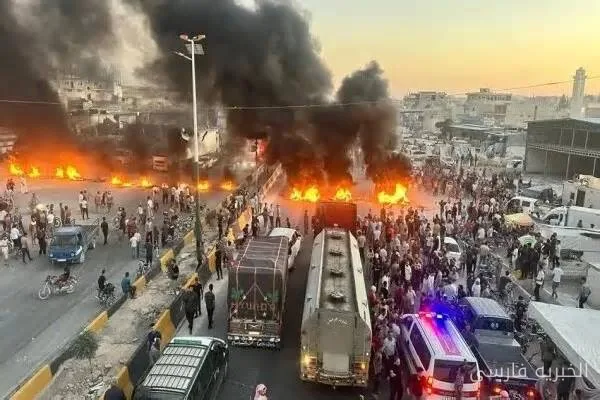
The sharp increase in fuel prices over the weekend has triggered the largest protests since the fall of Bashar al-Assad's regime about two years ago across Syria.
Reasons for the Protests
Demonstrators set fire to tires and blocked main roads, including the highway connecting Damascus to Aleppo, after the government announced on Saturday a 40% increase in diesel prices to 175 Syrian pounds (equivalent to $1.32) per liter. This decision has intensified the economic pressure on people who have been facing a livelihood crisis for years.
Read more: Reopening of Iran-Iraq Border Crossings: The Beginning of a New Era in Trade and Travel
The United Nations Development Program estimates that 90% of the Syrian population lives below the poverty line; this figure was about one-third of the population before the civil war began in 2011.
Rising Prices and Economic Problems
In addition to the 40% increase in diesel prices, the Syrian government has raised the prices of household and industrial gas by about 9%, super gasoline (95 octane) by 28% to 195 pounds, and regular gasoline (90 octane) by 26% to 185 pounds. Protesters have also blocked oil tanker convoys heading to central Syrian refineries and demanded the dismissal of the ministers of energy and economy, as well as the head of the Syrian National Oil Company.
In Aleppo, protesters emphasized the unbearable conditions and called on President Ahmad al-Shara to immediately reduce fuel prices and address the living situation.
Abdulhamid Salat, spokesperson for the Syrian Ministry of Energy, stated that this price increase is a temporary measure due to the rise in global fuel supply costs and the country's heavy dependence on imports, and it will be reconsidered as conditions change.
Syria is heavily reliant on Russian crude oil, importing about 60,000 barrels daily from the country this year; although Damascus has informed Washington that it wishes to significantly reduce these oil purchases. However, fuel imports from Moscow have been disrupted due to attacks on Russian refineries and export restrictions imposed by Moscow.
On the other hand, the three-month shutdown of the Baniyas refinery (Syria's largest refinery) for major repairs has exacerbated fuel shortages within the country. This price increase has caused the rate of super gasoline to rise by about 86% since February, and the price of diesel has more than doubled; this coincides with a 44% surge in Brent crude oil prices.
Read more: Saudi Arabia and Four Gaming Giants: A Revolution in the Gaming Industry · Why Hakan Fidan is Seeking the Dissolution of the Syrian Democratic Forces in Damascus?