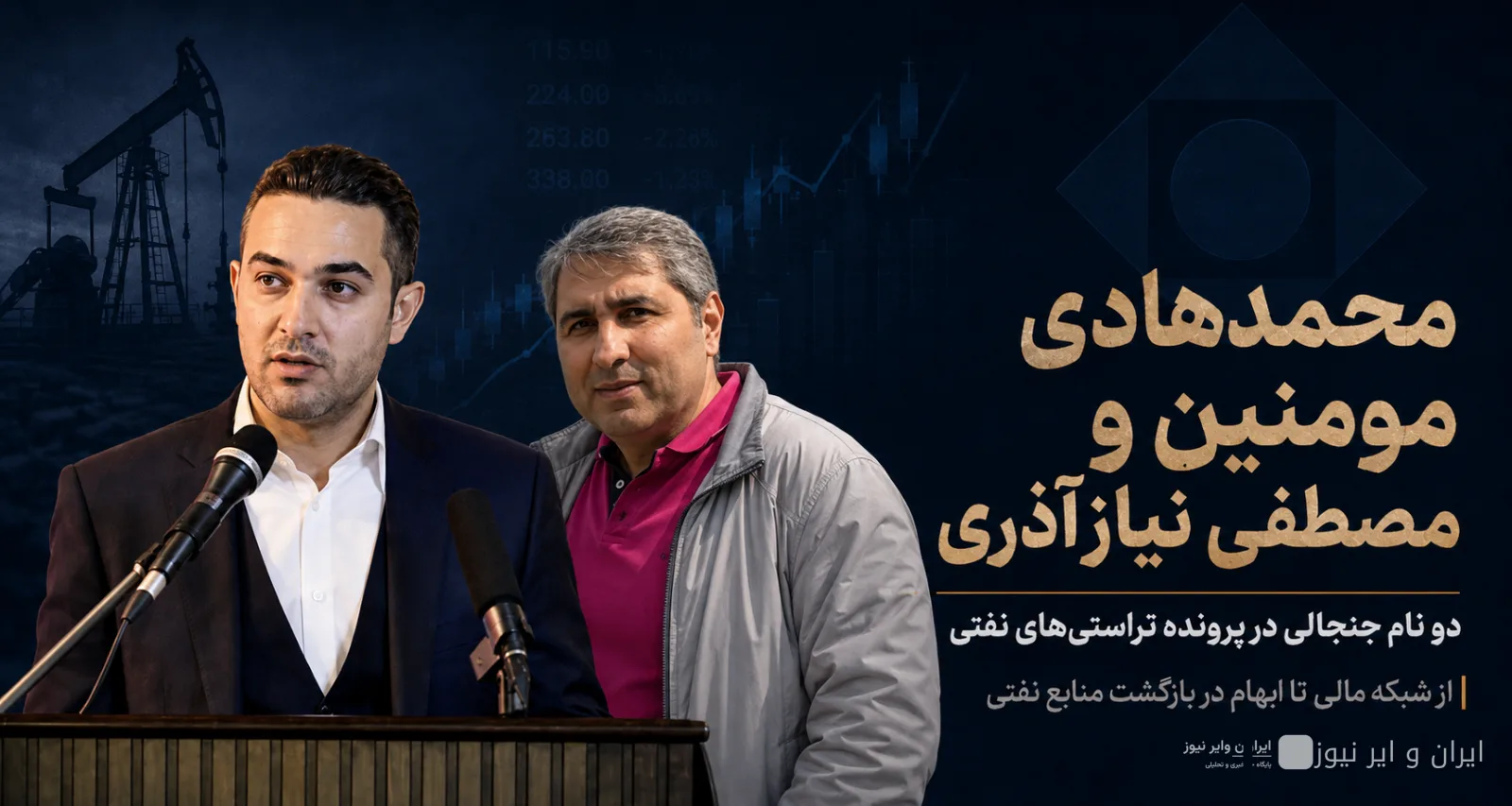
According to an IranWire News reporter, the oil trusts case has entered a phase where it can no longer be limited to just a few major debtors or a few oil traders, following the release of new names and more details about how sales intermediaries were selected and supported. Among the names mentioned in recent reports, two figures stand out as needing closer examination: Mohammad-Hadi Momenin and Mostafa Niazazari.
One is in the private sector, with a network of exchange offices, domestic and foreign companies, and a history of international business activity; the other is positioned where reports describe it as one of the potential coordination and communication links between parts of the trusts network and structures with a security background.
The inclusion of these two individuals in a case raises the main question from “who took the oil and did not return the money?” to a more significant level: who selected the intermediaries, what network supported them, and how did access to oil shipments and currency transfer routes come to be available to these individuals?
The foundational report on the trusts case emphasizes that the issue is not just about the debts of a few traders and that a mechanism must be examined that has enabled intermediaries to access oil shipments and financial resources.
Mohammad-Hadi Momenin; A Trustee with an Extensive Financial Network
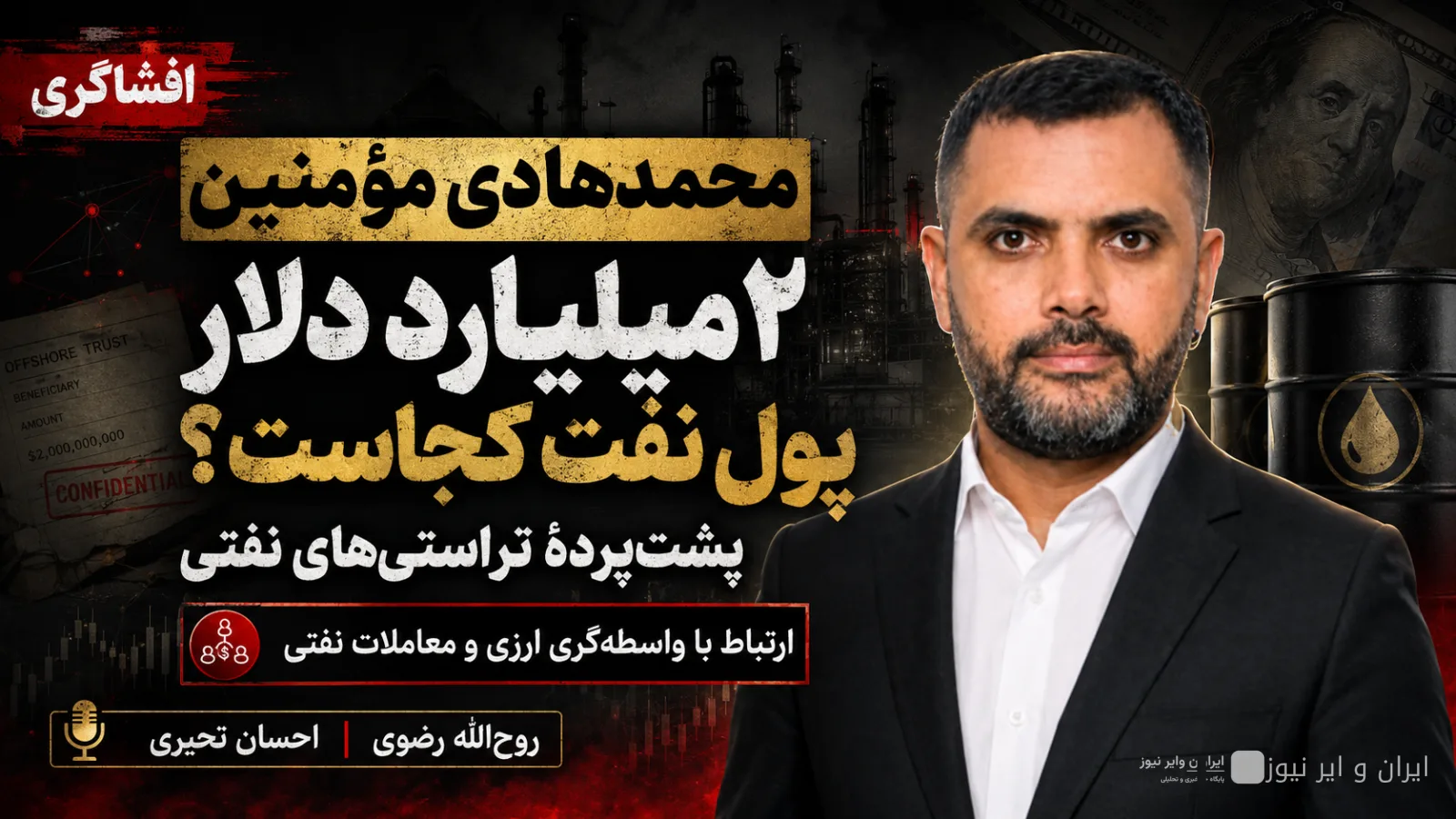
The name Mohammad-Hadi Momenin appears prominently in a significant part of the oil trusts case.
According to information gathered in the foundational report, approximately two billion dollars from oil sales revenue has been placed in Momenin's hands, and the return of these resources to the country has raised questions. The importance of this figure increases when the economic structure surrounding Momenin is also examined.
Momenin is not merely introduced as a simple oil sales intermediary. Published information reveals a network of financial activities, exchange offices, domestic and foreign companies, and international business communications surrounding him; an infrastructure that is crucial for the operation of a trust under sanctions.
In Tehran, the name “Exchange Office of Mohammad-Hadi Momenin and Partners” has been mentioned, which, according to the report, was registered under number ۵۰۵۸۹۸ on February ۱۱, ۲۰۱۷, and has also been cited with license number ۸۰۱۳۱.
The existence of such a financial network is significant because the role of a trustee is not limited to taking oil and finding a buyer. Receiving money, currency conversion, transferring resources between different accounts, using intermediary companies, and the final transfer of currency constitute a major part of the oil sales mechanism under sanctions.
Traces of Momenin's activities are also seen outside of Iran.
The report mentions the company Group Investment Momenin Ltd in the UK, where Mohammad-Hadi Momenin and Saeed Momenin have been involved in its management and ownership structure. Additionally, Mohammad-Hadi Momenin's name has also been mentioned in Cellpack Ltd.
In Iran, the names of Mohammad-Hadi and Saeed Momenin are seen in the structure of the company “Kaghaz Kar Kasra”. According to the report, Mohammad-Hadi Momenin has been a member and vice-chairman of the board of directors of this company at various times, and Saeed Momenin has also held the position of chairman of the board.
Momenin's international activities do not stop there.
In ۲۰۱۶, the Spanish company Telepizza collaborated with Group Investment Momenin to enter the Iranian market, and Mohammad-Hadi Momenin was introduced as the representative of this group. The published information also refers to him as the chairman of the board of the Momenin Industrial Group and a member of the board of the company “Axon Machine Arena.”
Momenin's name also appears in another section of the report regarding oil collaborations between Iran and Venezuela. According to the foundational report, his name has been mentioned in transactions related to the Venezuelan state oil company, PDVSA, and his involvement in the process of receiving or transferring funds from these transactions has been discussed.
Additionally, the published information mentions Mohammad-Hadi Momenin with ۷۴۳ billion tomans in debt to Kaarafarin Bank.
Putting these records together presents a picture of an individual who is not only recognized as an oil trader but also as someone who holds a multi-layered economic and financial network both inside and outside Iran.
However, the main question remains:
Who or what structure has granted such a level of access to oil and currency resources to Momenin?
Momenin's Connection with Shayan, Razavi, and Mohammad-Javad Baavand
The significance of Momenin's name increases when we place him alongside other individuals mentioned in this case.
Published information describes Mohammad-Hadi Momenin and Rouhollah Razavi as part of an interconnected network, and the name Mohammad-Javad Baavand has also been mentioned in connection with these two.
Mohammad-Javad Baavand is introduced in the report as a manager who, after a history of activity in the economic sectors of a security structure, entered the formal structure of the Ministry of Oil and ultimately served as the assistant minister for oil sales, condensates, and products, overseeing the Niko Company in one of the most sensitive positions related to Iran's foreign oil trade.
On the other side, there is an individual with the alias “Shayan”; a former director general of fuel and energy at the Ministry of Intelligence, whose networks are claimed to have moved beyond mere oversight and played a role in selecting and organizing oil trusts.
If this information is independently verified, the inclusion of Momenin's name alongside Shayan and Baavand takes on special significance; as one is in a supervisory position in the energy sector, another holds an official position related to oil sales, and Momenin occupies the private and financial side of the network.
For this reason, Momenin's case is not merely that of an oil debtor.
The more important issue is the mechanism that has enabled such a large volume of oil resources to be placed in his hands.
Mostafa Niazazari; A Potential Coordination Link
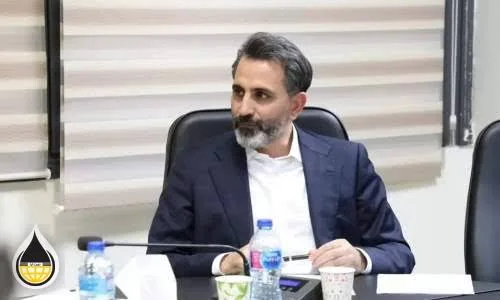
On the other side of this case is the name Mostafa Niazazari; an individual whose role is described differently from Momenin.
In the foundational report, Niazazari is introduced as one of the important figures in the trusts network, and his potential role in coordinating the network's communications with parts of the intelligence community is noted as a subject that requires further investigation.
According to published information, Mostafa Niazazari has previously been named as a suspect in one of the major corruption cases attributed to the judiciary and has a history of detention in a case of disruption in the economic system.
Another aspect that makes Niazazari's name more sensitive in this case is his family background.
His father, Kiomars Niazazari, is introduced in the report as one of the experienced managers of the Ministry of Intelligence and a former director general of intelligence in Mazandaran.
However, mere familial connection cannot, by itself, prove Mostafa Niazazari's role in the network, and this point should be considered in the examination of the case.
What is stated in the report specifically concerns his potential role in coordinating some of the network's communications; a subject that requires documents and independent investigation to prove.
Based on the model presented in the report, if we consider Shayan at the center of the selection and organization of trusts, Mohammad-Javad Baavand as the connection point to the official oil sales structure, and Mostafa Niazazari as one of the potential coordination links, names like Momenin and Razavi appear in the private sector, where oil resources and financial networks have been placed at their disposal.
This very structure makes the connection between Momenin and Niazazari meaningful within a significant case.
Momenin is positioned in the financial and commercial side; Niazazari is in the part that reports describe as a potential coordination link.
From Oil Debtor to Decision-Making Network
One of the mistakes in examining the trusts case could be to focus solely on the debts of individuals.
If Mohammad-Hadi Momenin truly has around two billion dollars in oil resources at his disposal, the question is not just what has happened to this money.
It must be clarified:
Who has selected Momenin as a trustee?
What agencies or officials have approved his qualifications?
How much oil has been placed at his disposal?
What guarantees were received before the shipments were delivered?
At what stage was the first debt or delay in the return of funds identified?
And most importantly, if there is a debt, who has authorized the continuation of cooperation and delivery of subsequent shipments?
The same questions also apply to Mostafa Niazazari's potential role.
If reports about his role in coordinating the network are accurate, it must be clarified at what level this coordination occurred, with whom he was in contact, and whether these communications influenced the selection or continuation of specific trusts' activities.
Competition Among Trusts and Access to Information
The case becomes more complicated when we also consider the issue of competition among trusts.
The foundational report does not present a picture of a single, centralized network but speaks of several parallel and sometimes rival networks, each having their trusted trusts, exchange offices, and banking channels, competing for a larger share of oil shipments.
In such an environment, access to confidential information can be as valuable as access to the oil itself.
Information about bank accounts, intermediary companies, currency transfer routes, buyers, shipments, and the financial structures of competitors can lead to the elimination of one trust and the strengthening of another.
For this reason, if networks with a history or security connections have played a role in the selection and support of trusts, it must be clarified whether the information available to supervisory bodies has also entered the competition among private intermediaries.
A Case That Does Not End with Momenin
The names Mohammad-Hadi Momenin and Mostafa Niazazari are just part of the long list of individuals mentioned in this case.
Alongside them, names such as Shayan, Mohammad-Javad Baavand, Rouhollah Razavi, Hossein Aghayari, Ali Bayandorian, Ahmad Ma'roufani, Ehsan Sekhayi, Ehsan Tahiri, Mohsen Fallahian, Ali Rezaei, and Ehsan Dashtgib have also been mentioned in the published reports.
The breadth of this list indicates that the case cannot be limited to the actions of one or two traders.
If the published information about the structure of this network is confirmed, we are faced with a collection where the private sector, oil sales managers, individuals with security backgrounds, legal networks, and financial channels are interconnected at various points.
What Questions Should Mohammad-Hadi Momenin and Mostafa Niazazari Answer?
For Mohammad-Hadi Momenin, the most important question concerns the actual amount of oil resources at his disposal, the status of the return of funds, the guarantees provided, and how he was selected as a trustee.
It should also be clarified what his connection with Mohammad-Javad Baavand, Rouhollah Razavi, and the network associated with Shayan has been.
Regarding Mostafa Niazazari, the main issue is clarifying his potential role in coordinating communications.
Did he really intervene in the selection or support of trusts?
If so, what was the nature and authority of this role, and during what period was it carried out?
What were his potential connections with Shayan, Baavand, Momenin, or other individuals mentioned in the case?
And can official or financial documents confirm these connections?
Until clear answers are provided to these questions, the oil trusts case will remain more a collection of significant and unanswered questions than a completed case.
Ultimately, Mohammad-Hadi Momenin can serve as an example of the economic and financial side of this case, while Mostafa Niazazari represents an example of a link that reports suggest may have played a role in coordinating the network's communications.
But the main question goes beyond both names:
What structure allowed individuals like Momenin to access Iran's billion-dollar oil resources, and what network was behind the selection, approval, and continuation of these trusts' activities?
Until this decision-making chain is clarified, a mere focus on the final debtors cannot reveal the true dimensions of the case.